
How Much Does a Pool Really Cost to Own in 2026?
The sticker price is just the beginning. Here is what a pool actually costs you every year in chemicals, electricity, insurance, and the expenses most people never see coming.
Somebody in your neighborhood just finished their pool. You walked by it last weekend. The kids were in it. The parents were sitting under an umbrella with cold drinks. And you thought the same thing everybody thinks: we should get one.
Then you looked up the price. And it was not just the price of the pool. It was the concrete patio, the fencing, the permit, the landscaping, and the look on your spouse's face when you showed them the number. That is the part you expected.
What most people do not expect is the second number. The one that shows up every single month for as long as you own the pool. Chemicals. Electricity. Insurance. Water. Repairs. Equipment replacements. Opening and closing costs. That second number is the one that catches people off guard, and it is the one nobody talks about at the neighborhood barbecue.
What It Costs to Put a Pool in the Ground
The average inground pool installation in 2026 costs about $65,000. That is the national average. The real range is $40,000 to over $200,000 depending on what you build and where you build it.
Vinyl liner pools are the least expensive to install, running $40,000 to $65,000 for a standard size. Fiberglass pools land in the middle at $74,000 to $110,000. Concrete or gunite pools are the most expensive at $95,000 to $225,000 because they are fully custom and take the longest to build.
Those numbers include the pool itself, basic decking, the pump and filter system, and standard fencing to meet code. They do not include upgraded landscaping, lighting, a heater, an automatic cover, or any of the extras that turn a $65,000 pool into a $120,000 project before you realize what happened.
Above ground pools are a different story. A decent above ground setup runs $3,000 to $15,000 installed. They do not add resale value and they cost roughly the same to maintain as a small inground pool, but the upfront number is dramatically lower. If the question is “can I get a pool for under $10,000,” the answer is yes, but only above ground.
The Annual Cost Nobody Warns You About
The honest answer is that annual cost varies dramatically based on whether you maintain the pool yourself or hire a service. A DIY owner can run a pool for $1,500 to $3,500 a year. A homeowner using a weekly professional pool service typically spends $4,000 to $8,000 a year. The $12,000 or more figure shows up for luxury pools, large gallon counts, or homeowners in high-electricity-rate states using older single-speed pumps.
For most homeowners the realistic monthly cost lands between $125 and $670 a month, 12 months a year, including the months you are not swimming. That is the range to budget against before you commit.
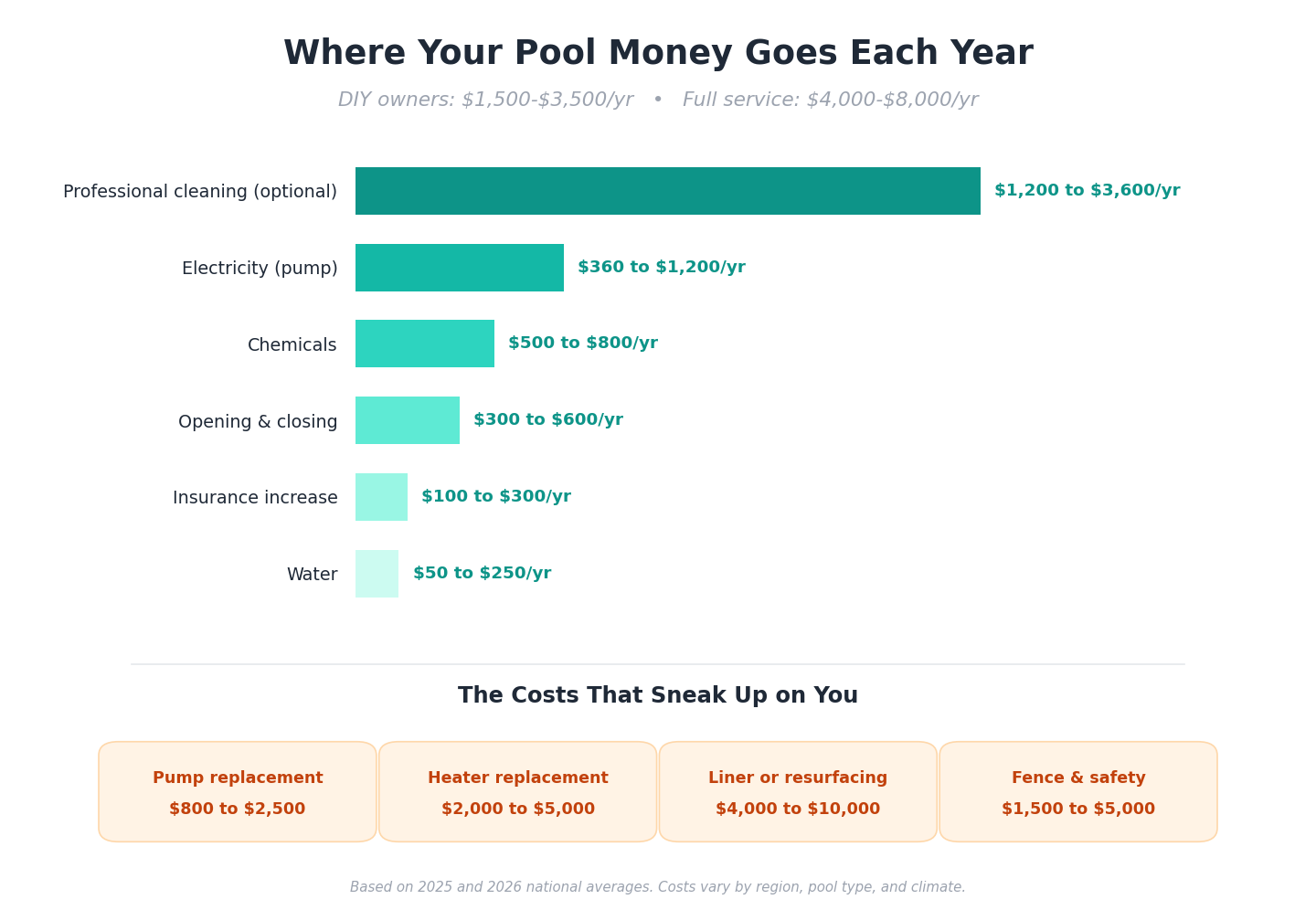
Here is where that money goes.
Chemicals: $500 to $800 per year. Chlorine, pH balancers, algaecides, shock treatments. A chlorine pool runs about $50 to $80 a month during swimming season. Saltwater pools use fewer chemicals at about $20 to $40 a month, but the salt cell needs replacing every 3 to 7 years at $500 to $1,200.
Electricity: $360 to $1,200 per year. The pump is the big one. A single speed pump running 8 to 12 hours a day costs $80 to $150 a month depending on your electricity rate. A variable speed pump cuts that by up to 80%, saving $5,000 to $9,000 over 10 years. If you are building a new pool, the variable speed pump is one of the smartest investments you can make. Use the Electricity Cost Calculator to see what your pump actually costs to run at your local electricity rate.
Water: $50 to $250 per year. Evaporation, splash out, backwashing the filter, and the occasional drain and refill. In hot, dry climates this number runs higher. A standard 15,000 gallon pool can lose 1 to 2 inches of water per week in the summer. Use the Pool Volume Calculator to figure out exactly how many gallons your pool holds.
Professional cleaning: $1,200 to $3,600 per year. If you hire a weekly service, expect $100 to $300 a month. That covers skimming, vacuuming, chemical balancing, and filter checks. If you do it yourself, you save that money but you are spending 2 to 4 hours a week on pool maintenance instead.
Insurance: $100 to $300 per year.Your homeowner's insurance premium goes up when you add a pool. Most insurers also require you to increase your liability coverage from $100,000 to $500,000. Some homeowners add an umbrella policy on top of that for another $200 to $400 a year. The pool is an “attractive nuisance” in insurance terms, which means it increases your liability whether anyone is swimming or not.
Opening and closing: $300 to $600 per year. If you live somewhere with a real winter, you are paying to winterize the pool in the fall (draining lines, adding antifreeze, covering it) and to open it back up in the spring (cleaning, refilling, rebalancing chemicals, starting up equipment). If you DIY it, budget for your time and the supplies.
The Costs That Sneak Up on You
The monthly costs are predictable. It is the irregular expenses that catch people. Here are the big ones.
Pump and motor replacement: $800 to $2,500. Pool pumps last 8 to 12 years. When they go, you do not have the luxury of shopping around because your pool turns green in about 48 hours without circulation.
Heater replacement: $2,000 to $5,000. Gas heaters last 7 to 10 years. Heat pumps last longer at 10 to 15 years but cost more to replace. If you heat your pool, this is not a question of if. It is a question of when.
Vinyl liner replacement: $4,000 to $7,000.If you went with a vinyl liner pool to save money on installation, you will spend $4,000 to $7,000 every 5 to 9 years replacing the liner. Over 20 years that is $8,000 to $28,000 in liner costs alone. That “cheaper” pool catches up.
Concrete resurfacing: $5,000 to $10,000. Plaster finishes on concrete pools last 7 to 15 years before they need resurfacing. Pebble finishes last longer at 15 to 20 years but cost more to refinish.
Fence and safety compliance: $1,500 to $5,000.Most municipalities require a fence or barrier around the pool. If your existing fence does not meet code (most don't), you are adding or modifying fencing. Factor in a self-closing gate, alarms, and a pool cover if your area requires one.
Property tax increase: varies.In many states, an inground pool increases your property's assessed value, which means higher property taxes. The increase depends on your location and assessment method, but $200 to $800 per year is common.
The 10 Year Math
Here is what 10 years of pool ownership looks like for a standard inground pool with professional maintenance.
Installation: $65,000. Annual maintenance and operating costs at $7,000 per year for 10 years: $70,000. One pump replacement: $1,500. One heater replacement: $3,500. One liner replacement (vinyl) or one resurfacing (concrete): $5,000 to $7,000. Insurance and property tax increases: $5,000 to $8,000.
Total 10 year cost: roughly $150,000 to $155,000.
That is $15,000 a year or about $1,250 a month. For context, that is more than a lot of people spend on their car payment. It is not a reason to skip the pool. It is a reason to go in with your eyes open.
If you are comparing this to the cost of other ways to keep your family entertained, consider that a family of four spending $100 a week on outings, activities, and day trips is already at $5,200 a year. The pool replaces some of that. Not all of it, but some. Whether the math makes sense depends on how much you will actually use it. If you are trying to get a handle on what your overall monthly home expenses look like with a pool added in, run those numbers too.
Does a Pool Add Value to Your Home?
This is the question everybody asks and the answer is complicated. A pool typically adds 1% to 7% to your home's value. On a $400,000 home, that is $4,000 to $28,000. The ROI on pool installation is generally 40% to 60%, meaning a $65,000 pool adds about $26,000 to $39,000 in resale value.
Location matters more than anything else. In Arizona, Florida, Southern California, and parts of Texas, a pool is expected in many neighborhoods and the value bump is higher. In Minnesota, Oregon, or the Northeast, a pool can actually be a negative because buyers see it as a maintenance burden they do not want to inherit.
Above ground pools add essentially zero resale value. Most appraisers treat them as personal property, not a home improvement. If resale value is part of your decision, only an inground pool counts.
The honest answer is this: do not build a pool as an investment. Build it because your family will use it and enjoy it. If it bumps the resale value later, that is a bonus. If you are buying or selling a home and want to understand how something like a pool affects the overall picture, the True Cost of Homeownership Calculator can help you factor everything in.
How to Cut the Cost Without Cutting Corners
You cannot eliminate pool costs, but you can reduce them significantly with a few smart moves.
Install a variable speed pump. This is the single biggest money saver for any pool owner. They cost more upfront at $800 to $1,500 versus $300 to $800 for a single speed, but they save $400 or more per year on electricity. They pay for themselves in 2 to 3 years and last just as long.
Use a pool cover. A solar cover reduces water evaporation by up to 95% and keeps the pool warmer so you run the heater less. Cost: $50 to $300 for a solar cover, or $5,000 to $15,000 for an automatic safety cover that also meets fencing requirements in some areas.
Learn to do basic maintenance yourself. Testing water chemistry, skimming, and vacuuming takes about 30 minutes a week once you know what you are doing. That saves $1,200 to $3,600 a year in service fees. Keep the pro for the opening, closing, and anything that involves equipment repair.
Buy chemicals in bulk at the start of the season. Big box stores and warehouse clubs sell pool chemical kits at significant discounts in April and May. Buying a season's worth of chlorine and shock upfront can save 20% to 30% compared to buying as you go.
Run the pump during off peak hours. Many utilities charge less for electricity at night. Running your pump from 10 PM to 6 AM instead of during the day can cut your electricity cost by 15% to 30% depending on your rate plan. Check with your utility to see if you are on a time of use plan. The Electricity Cost Calculator can help you compare peak versus off peak costs.
Should You Build the Pool?
That depends on one thing: how much will you actually use it?
If you are in a warm climate and your family will be in the pool from May through October, the per use cost can be very reasonable. A family that swims 4 to 5 days a week for 6 months is getting roughly 100 to 130 uses per year. At $7,000 a year in operating costs, that is $54 to $70 per swim day for the whole family. Compare that to a waterpark or pool club membership and the math starts to make sense.
If you are in a short season climate and you will realistically use it June through August, you are looking at maybe 40 to 50 uses per year. That same $7,000 annual cost works out to $140 to $175 per swim day. That is a lot harder to justify.
The pool itself does not care whether you use it or not. It costs the same whether you swim every day or once a month. The chemicals still need balancing. The pump still runs. The insurance premium does not go down because you had a busy summer. The only variable is how much value you get out of those fixed costs.
Run your numbers. Know the real cost. Then decide.
Pool installation and maintenance costs vary by region, pool type, and local market conditions. All figures in this article are based on 2025 and 2026 national averages and are intended as general guidance. Get quotes from local contractors for pricing specific to your area.