

Adopting a dog is one of the best decisions you can make. But it's also a financial commitment that catches a lot of people off guard. The adoption fee or purchase price is just the entrance ticket. The real costs show up every month for the next 10 to 15 years.
According to Rover's 2025 True Cost of Pet Parenthood report, annual dog care costs range from $1,390 to $5,295 depending on the size of your dog, where you live, and what kind of care you provide. Over a dog's lifetime, that adds up to roughly $34,550.
That's a wide range. Let's break it down into the actual categories so you know where the money goes.
Food: $250 to $1,200 per year
Food is the most predictable recurring cost, and it scales directly with your dog's size. A 10-pound Chihuahua eats a fraction of what a 90-pound Labrador goes through.
For standard dry kibble, expect to spend $20 to $40 per month for a small dog and $60 to $100 per month for a large breed. The U.S. average annual dog food expenditure has risen to $548 in 2026, up 12% since 2023 according to the American Pet Products Association.
Premium, grain-free, or fresh food options push costs higher. Subscription fresh food services like The Farmer's Dog or Spot & Tango can run $150 to $300 per month for a medium-sized dog. That's potentially $3,600 a year on food alone.
Use our Dog Food Calculator to estimate your specific dog's daily intake and monthly food cost based on weight, age, and activity level.
Veterinary care: $500 to $1,500 per year (routine)
A healthy adult dog needs at least one vet visit per year for a wellness exam, vaccinations, and preventive medications. A routine wellness visit runs $200 to $500 depending on your location and what's included.
Vet costs are rising faster than almost any other pet expense. Bureau of Labor Statistics data from February 2026 shows veterinary services up 5.3% year over year. A basic exam that cost $62 nationally a few years ago now runs $70 to $130 in urban areas.
Preventive medications for heartworm, flea, and tick prevention add another $200 to $400 per year. These aren't optional. Heartworm treatment after infection can cost $1,000 to $3,000 and is dangerous for the dog.
And that's just routine care. Emergency vet visits are a different category entirely.
Emergency vet bills: the wildcard
This is the expense nobody plans for until it happens. Swallowed a sock? That's a $2,000 to $5,000 surgery. Torn ACL? $3,500 to $5,500. Cancer treatment? $5,000 to $10,000 or more.
A MetLife Pet Insurance study found that health-related expenses alone exceeded $1,100 annually for the average pet parent in 2025. And that's the average. Many dog owners face a single emergency that costs more than an entire year of routine care.
Pet insurance runs $30 to $70 per month depending on breed, age, and coverage. Whether it's worth it depends on your risk tolerance and savings. If you don't get insurance, financial advisors recommend keeping $2,000 to $5,000 in a dedicated pet emergency fund. Our Emergency Fund Calculator can help you figure out a target that includes pet emergencies.
Grooming: $0 to $1,200 per year
This one varies wildly by breed. A short-haired Beagle might need nothing more than a bath at home every few weeks. A Goldendoodle or Poodle needs professional grooming every 6 to 8 weeks at $50 to $100 per session.
Budget $0 to $50 per year for low-maintenance breeds and $600 to $1,200 for breeds that require regular professional grooming. If you're choosing a breed, this is worth factoring in. The difference over a dog's lifetime is thousands of dollars.
The costs most people forget
Beyond the big categories, there's a long tail of smaller expenses that add up quietly throughout the year.
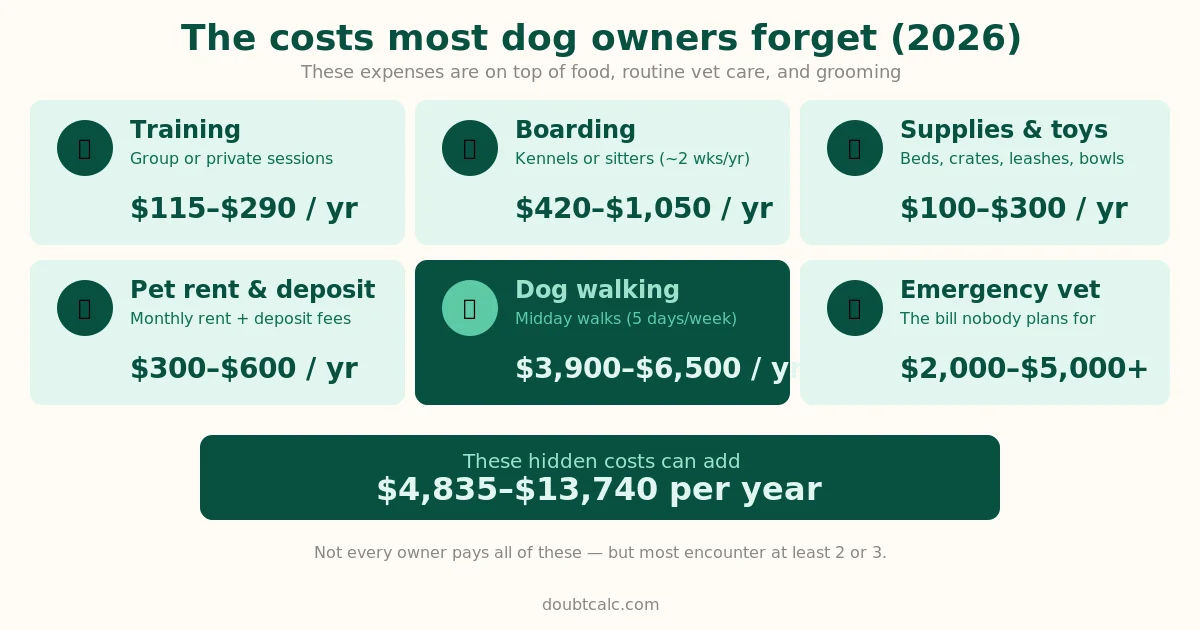
Training: Group obedience classes run $115 to $290 per year. Private training for behavioral issues can cost $50 to $150 per session.
Boarding and pet sitting: If you travel, boarding runs $30 to $75 per night. Two weeks of vacation a year means $420 to $1,050 in boarding costs. In-home pet sitters are similar or slightly higher.
Supplies and toys: Leashes, beds, crates, bowls, toys, and replacements for everything your dog destroys. Budget $100 to $300 per year.
Pet rent and deposits: If you rent, many landlords charge $25 to $50 per month in pet rent plus a $200 to $500 non-refundable pet deposit. That's $300 to $600 per year just for the privilege of having a dog in your apartment.
Dog walking: If you work long hours, a midday dog walker costs $15 to $25 per walk. Five days a week adds up to $3,900 to $6,500 per year.
Total cost by dog size
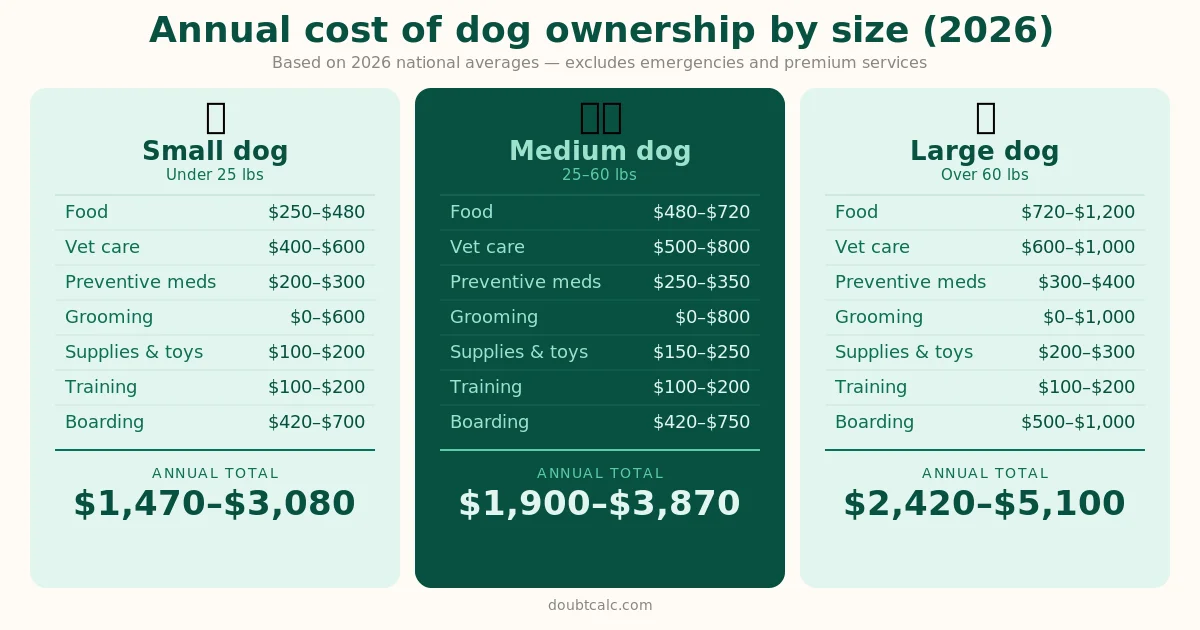
Here's a realistic annual breakdown for an adult dog receiving standard care, not including emergencies or premium services:
| Expense | Small Dog | Medium Dog | Large Dog |
|---|---|---|---|
| Food | $250 to $480 | $480 to $720 | $720 to $1,200 |
| Vet (routine) | $400 to $600 | $500 to $800 | $600 to $1,000 |
| Preventive meds | $200 to $300 | $250 to $350 | $300 to $400 |
| Grooming | $0 to $600 | $0 to $800 | $0 to $1,000 |
| Supplies & toys | $100 to $200 | $150 to $250 | $200 to $300 |
| Training | $100 to $200 | $100 to $200 | $100 to $200 |
| Boarding (2 wks) | $420 to $700 | $420 to $750 | $500 to $1,000 |
| Annual total | $1,470 to $3,080 | $1,900 to $3,870 | $2,420 to $5,100 |
Want a personalized estimate? Our Pet Cost Calculator lets you plug in your specific situation (breed size, care choices, and local costs) and see a yearly and lifetime number.
First-year costs are higher
The first year of dog ownership costs significantly more than subsequent years. Upfront expenses include adoption or purchase fees ($50 to $3,000+), spay/neuter surgery ($200 to $600), initial vaccinations ($100 to $300), microchipping ($25 to $75), and starter supplies like a crate, bed, bowls, and leash ($200 to $500).
All in, expect your first year to cost $1,000 to $3,000 more than a typical year. After that, costs settle into a more predictable rhythm, until your dog reaches senior age (around 7 to 10 years), when vet bills tend to climb again.
How to budget for a dog
The smartest approach is to set up a dedicated monthly transfer into a "dog fund" account. For a medium-sized dog getting standard care, $200 to $350 per month covers recurring expenses with a small cushion for surprises. For large breeds, budget $250 to $450 per month.
On top of that monthly budget, keep an emergency reserve of $2,000 to $5,000 for unexpected vet bills. Build it gradually if you need to. Even $50 a month gets you to $2,400 in four years.
Use our Savings Goal Calculator to figure out how much to set aside each month to hit your pet emergency fund target by a specific date.
The bottom line
A dog is one of the most rewarding things you can bring into your life. But financially, you're looking at $1,400 to $5,000 per year for the next decade or more. Knowing that number upfront doesn't make the decision harder. It makes the experience better, because you're not caught off guard when the bills arrive.
Do the math before you adopt, not after. Your future self and your dog will thank you.
Note:All cost estimates in this article are based on 2025 and 2026 national averages from sources including Rover, the American Pet Products Association, MetLife Pet Insurance, and the Bureau of Labor Statistics. Your actual costs may vary based on location, breed, and care choices. This is not financial advice. It's a starting point for planning.