
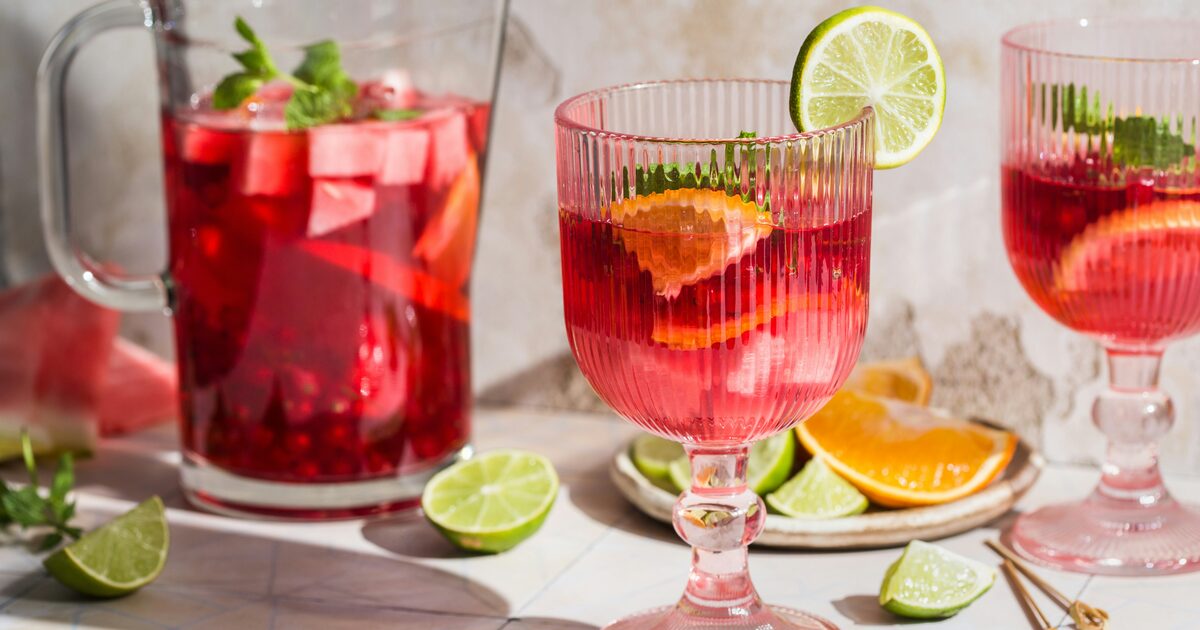
Here is a scene that plays out at every party I host. I find a great cocktail recipe, I make one for myself, and it is perfect. Restaurant quality. I am feeling confident. Then 15 people show up, and suddenly I am trapped in the kitchen muddling mint like a man possessed while everyone else is in the backyard having the time of their lives.
By the time I have made six drinks for people, I start eyeballing the measurements. After making ten, I have given up measuring entirely and I am just pouring things. Somewhere around the twelfth one my buddy asks why his mojito tastes like mouthwash, and I pretend I did not hear him.
The fix is embarrassingly simple: make the whole thing in one big batch before anyone arrives. But "just multiply the recipe" is the kind of advice that sounds right and goes wrong fast. There is a little bit of math involved, and if you skip it, you end up with 2 gallons of something that tastes nothing like the drink you nailed for yourself.
Why your drink tastes different when you scale it up
When you make a single cocktail, the shaker or stirring glass does something you probably never think about: it adds water. As ice melts during those 10 to 15 seconds of shaking, roughly 25% of the final drink volume comes from dilution. That water is not an accident. It is what takes a cocktail from "whoa, that is strong" to "this is smooth and balanced."
When you pour a big batch into a pitcher and skip the shaking step, you skip the dilution. The result is a drink that is noticeably boozier and sharper than the single serve version you tested. Your guests will notice. They will be polite about it, but they will notice.
The fix: for every cocktail serving in the batch, add about 1 oz of water. Making margaritas for 20 people? That is 20 oz of water stirred right into the batch. It feels wrong to add water to perfectly good tequila, but trust the process. This is the single biggest reason batch cocktails go sideways.
The actual math (it is easier than you think)
Scaling a cocktail recipe is just multiplication, but you have to multiply the right number. Here is the process:
Start with your single serve recipe. Write down every ingredient and its measurement. A classic margarita might be 2 oz tequila, 1 oz lime juice, and 0.75 oz triple sec. That is 3.75 oz of liquid per drink before dilution.
Next, figure out your total drink count. The standard party estimate is 2 drinks in the first hour and 1 drink per hour after that. For a 4 hour party with 15 guests, that works out to about 60 drinks. Yes, that sounds like a lot. No, you will not have a ton left over. People drink more than you think they will, especially when the drinks are good and the pitcher is right there.
Multiply each ingredient by the number of servings. Then add 1 oz of water per serving for dilution. For that 60 drink margarita batch, you would need 120 oz of tequila (a little over 3 standard 750ml bottles), 60 oz of lime juice, 45 oz of triple sec, and 60 oz of water. Our batch cocktail calculator does all of this for you and converts to cups, liters, and bottles so you know exactly what to buy.
Carbonation: the one thing you cannot batch
If your cocktail has anything fizzy in it (club soda, ginger beer, tonic water, sparkling wine) do not put it in the batch. I learned this one the hard way. I made a beautiful batch of palomas, poured in an entire 2 liter of grapefruit soda, and by the time the third guest poured a glass it was completely flat. Two liters of expensive sparkling sadness.
Instead, make the base batch with everything except the carbonated ingredient. When guests pour a glass, they top it off with the fizzy stuff themselves. Set out the bottles of soda or sparkling wine next to the pitcher with a little note that says how much to add (something like "fill the last third of your glass with club soda"). It takes ten seconds and keeps the fizz alive.
How to shop without doing math in the liquor store aisle
There is a special kind of panic that hits when you are standing in the spirits aisle trying to convert ounces to bottles in your head while someone behind you is waiting to grab the bourbon. A standard 750ml bottle holds about 25.4 oz. A handle (1.75L) holds about 59 oz. That is the only conversion you need.
For a party of 15 to 20 people serving 2 to 3 drinks each, you will typically need 2 to 3 standard bottles of the base spirit. One bottle of each modifier (triple sec, vermouth, simple syrup) is usually enough unless the recipe is heavy on a particular ingredient. Buy one extra bag of citrus beyond what the math says because some limes are juicier than others and you do not want to find that out at 6pm.
Pro move: run your recipe through the batch cocktail calculator before you leave the house. It gives you a shopping list broken down by bottles, which is a lot more useful than staring at "120 oz of tequila" and trying to figure out how many fifths that is.
How far ahead can you make it?
The base batch (spirits, juices, syrups, and water) can be mixed up to 24 hours before the party and stored in the fridge. In fact, it actually tastes better after sitting for a few hours because the flavors have time to blend together. Bartenders call this "marrying" the ingredients, and it is one of the few times in cooking where laziness is rewarded.
There are two exceptions. Fresh citrus juice starts to lose its brightness after about 4 to 6 hours, so if your recipe is citrus heavy (like a margarita or a whiskey sour), squeeze the juice the morning of the party rather than the night before. And as mentioned, hold all carbonated ingredients until serving time.
For storage, any large pitcher, beverage dispenser, or even a clean stock pot works. Mason jars are great for smaller batches. Label everything if you are making more than one cocktail because unlabeled pitchers of brown liquid lead to some interesting conversations.
Garnishes: keep it simple or skip them entirely
Look, I know the cocktail looks amazing in the recipe photo with a perfectly carved lime wheel and a sprig of rosemary and a sugar rim that would make a bartender weep. But you are making drinks for 20 people, and if you try to garnish all of them you are right back to where you started: stuck in the kitchen while everyone else is having fun.
Set out a small garnish station instead. A bowl of lime wedges, a dish of salt for rimming, maybe some fresh mint if the cocktail calls for it. Let guests garnish their own glass. It takes the work off your plate and people actually enjoy customizing their own drink. Plus, the person who wants seven lime wedges in their glass can go wild without you judging them. (You will still judge them. But silently.)
The ice situation
People always underestimate ice. Always. The standard rule is 1 pound of ice per guest for parties under 3 hours and 1.5 pounds for longer events. A standard bag from the gas station or grocery store is about 10 pounds, so for a 20 person party you need 2 to 3 bags minimum.
Here is the thing about ice at a party: it is doing double duty. Some of it goes into glasses, and some of it keeps the batch cold. If you are serving the batch from a dispenser or a large bowl, you will need extra ice to keep it chilled throughout the evening. A cooler full of ice with the pitcher sitting inside it works great and looks more intentional than a bucket.
Do not put ice directly into the batch pitcher. It will melt and water down the cocktails over time, which means the first glass is perfect and the last glass tastes like flavored water. You already added the right amount of dilution when you built the batch. Keep the ice in the glasses and around the pitcher, not in it.
Cocktails that batch well (and ones that do not)
The best batch cocktails are the ones with simple ratios and no egg whites, no muddled fruit, and nothing that needs to be blended. Margaritas, sangria, palomas, whiskey sours (without the egg white), rum punch, and Moscow mules (with the ginger beer on the side) are all excellent candidates.
Cocktails that do not batch well include anything with cream or dairy (it separates), anything with egg whites (you need the shaking to create the foam), and frozen blended drinks unless you own a commercial blender and enjoy the sound of it running for 45 straight minutes.
If you want to offer variety without making three different batches, pick one signature cocktail for the batch and set out beer, wine, and a simple self serve option (like a gin and tonic station) for guests who want something different. One great batch cocktail beats three mediocre ones every time.
Frequently asked questions
Can I just multiply a cocktail recipe to make a batch?
You can multiply the base ingredients directly, but you also need to add about 1 oz of water per serving to account for the dilution that normally comes from shaking or stirring with ice. Without it, the batch will taste stronger and harsher than the original recipe.
How far ahead can I make a batch cocktail?
You can mix the base batch up to 24 hours ahead and keep it in the fridge. Just hold off on adding carbonated ingredients until right before serving. Fresh citrus juice is best squeezed the morning of the party.
How many drinks should I plan per guest?
The standard estimate is 2 drinks in the first hour and 1 per hour after that. For a 4 hour party with 20 guests, plan for about 80 servings total. Use our batch cocktail calculator to scale the recipe to your exact guest count.
How much ice do I need for batch cocktails?
Plan for about 1 pound per guest for shorter parties and 1.5 pounds for events over 3 hours. A standard store bag is about 10 pounds, so a 20 person party needs 2 to 3 bags. Keep ice in the glasses and around the pitcher, not in the batch itself.
Stop doing drink math in your head
Enter your recipe once, set your guest count, and get a full shopping list with bottle counts, ice estimates, and cost per drink.
Open the Batch Cocktail Calculator