
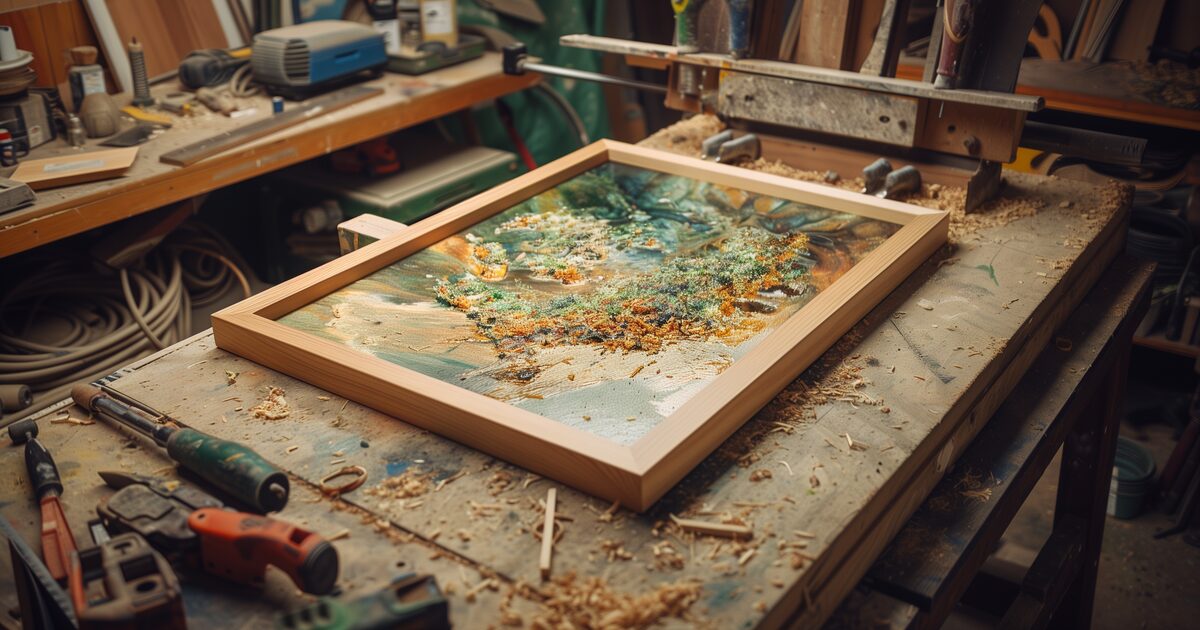
Why floating frames cost so much at shops
A floating frame is one of the simplest builds in woodworking. Four mitered pieces of wood, a backing board, and some offset clips to hold the canvas in place. The entire assembly takes about an hour once you have your cuts made.
Custom framing shops charge based on a united inch formula: the width of your art plus the height, multiplied by a per-inch rate, plus a base fee. For a 24x36 canvas, that formula typically lands between $150 and $350 depending on the shop, your location, and the frame material. According to HomeGuide, the national average for custom framing in 2026 runs $80 to $500 per piece.
The materials themselves account for roughly 15 to 20 percent of what you pay. The rest covers labor, rent, equipment, design consultation, and margin. That is not unreasonable for a business, but it means you are paying $120 or more in overhead for a build that requires about $20 in pine and an hour of your time.
The sizing formula you need to know
The number one mistake people make with floating frames is getting the inside dimensions wrong. The formula is simple once you see it, but it is buried in forum threads and rarely explained clearly in the videos that show up on YouTube.
Frame inner opening = art width + (gap x 2) by art height + (gap x 2)
Frame outer size = inner opening + (frame face width x 2) in each direction
For example, a 24x36 canvas with a 3/8 inch float gap and 1.5 inch wide frame stock gives you an inner opening of 24.75 x 36.75 inches and an outer dimension of 27.75 x 39.75 inches.
The other critical measurement is rabbet depth, which is the channel inside the frame that holds the canvas. Standard stretched canvases are 1.5 inches deep (sometimes called gallery wrap). Your rabbet needs to be at least 1.75 inches to give clearance for the canvas plus the offset clips or spacer blocks that hold it in place. If you are using 3/4 inch thick canvas bars, you need at least 1 inch of rabbet depth.
Our floating frame calculator does all this math for you and gives you a cut list with exact measurements, plus a cost comparison so you can see the savings before you buy a single board.
Materials list (what to buy at the store)
For a standard 24x36 canvas floating frame in pine, here is your shopping list:
Frame stock: Two 8 foot 1x2 boards (select pine or common board). This gives you roughly 16 linear feet, which covers all four frame pieces plus waste for miter cuts. Cost: $6 to $12.
Backing board: One piece of 1/4 inch plywood or MDF cut to your inner opening dimensions. Most hardware stores will make the cut for you at no charge. Cost: $8 to $12 for a 2x4 sheet.
Offset clips: Small Z-shaped metal clips that screw into the frame and grip the back of the canvas to hold it in place with the gap visible. A pack of 8 runs about $4 to $6 at any hardware store or online.
Hanging hardware: Two D-ring hangers and picture wire. Cost: $4 to $6.
Wood glue and pin nails: Standard wood glue for the miter joints, plus 1 inch pin nails or 18-gauge brad nails shot from the back. You likely already have glue. A box of brad nails is $4.
Finish: One small can of stain, paint, or polyurethane. Cost: $6 to $10.
Total for a 24x36 frame in pine: $32 to $50 buying everything fresh. If you already have wood glue, sandpaper, and finish in the garage, the frame-specific materials (wood, backing, clips, hardware) run $22 to $36 for a 24x36 canvas. Smaller canvases like 16x20 often come in under $25 total.
Tools you actually need
Must have: A miter saw (or a miter box with a hand saw for smaller frames), a measuring tape, wood glue, clamps (a band clamp is ideal for frames), and a way to drive nails (pin nailer, brad nailer, or a hammer with finish nails).
Nice to have:A table saw or router for cutting a rabbet if your stock does not have one, a corner clamp set, and a carpenter's square to check that your corners are true 90 degrees.
If you do not own a miter saw, most Home Depot and Lowe's locations rent them for $40 to $55 per day. Even factoring in the rental, you are still spending less than half what a framing shop charges. And if you have multiple canvases to frame (which is usually the case), you knock them all out in one rental session.
The build process (step by step)
1. Calculate and mark your cuts. Use the sizing formula above or plug your numbers into the calculator. Mark both the long edge (outer dimension) on each piece. You need two pieces at the horizontal length and two at the vertical length.
2. Cut your miters. Set your miter saw to exactly 45 degrees. Cut one end of each piece first, then measure from the long point and cut the other end. The long edge of each piece should equal the outer frame dimension for that side.
3. Dry fit. Lay all four pieces together on a flat surface and check that the corners are tight with no gaps. If a corner is open on the front face, your miter angle is slightly off. Adjust and recut before gluing.
4. Cut or route the rabbet. If your stock does not already have a channel, you need to create one. Set your table saw fence to cut a 1/4 inch deep channel on the inside back edge, then flip and cut again to remove the waste. The channel should be at least 1.75 inches deep for standard 1.5 inch canvases. Some builders skip this step by using L-shaped molding that already has the profile built in.
5. Glue and nail. Apply wood glue to both miter faces, align the joint, and shoot two pin nails from the back side. Wrap all four corners with a band clamp and let it sit for at least 30 minutes. Wipe any squeeze-out immediately with a damp cloth.
6. Sand and finish. Once the glue is dry, sand the frame to 220 grit. Apply your choice of stain, paint, or clear coat. Let it dry completely before handling.
7. Attach backing and hardware. Cut your 1/4 inch plywood backing to the inner opening size and attach it to the back of the frame with small screws or glazing points. Install D-ring hangers about one-third of the way down from the top on each side and string your picture wire.
8. Float the canvas. Place your canvas face-down on a soft surface. Set the frame over it (also face-down). Use small spacer blocks cut to your gap width as temporary shims, then attach offset clips to the frame that grip the back of the canvas stretcher bars. Remove the shims and flip it over. Done.
Choosing the right wood
Pine or whitewood ($1.50 per linear foot): The most forgiving option for beginners. Takes stain well and is available at every hardware store. The grain is visible but not overpowering. Best if you plan to stain a natural tone or paint it.
Poplar ($2.50 to $3 per linear foot): Smoother grain than pine and paints beautifully. If you want a solid white, black, or colored frame, poplar gives you the cleanest surface. Slightly harder to find at big box stores but usually available in the hardwood section.
Red oak ($4 to $5 per linear foot): Classic visible grain with a warm tone. Looks great with a natural or amber stain. Heavier than pine, which adds a premium feel. Requires a sharper blade for clean miters.
Walnut ($7 to $9 per linear foot): The premium choice. Rich dark brown that looks stunning with just a clear oil finish. Expensive, but a walnut floating frame still costs a fraction of what a shop charges. Just make sure your blade is sharp because walnut blows out easily on exit cuts.
For your first frame, start with pine. If the build goes well and you enjoy the process, upgrade to oak or walnut on your next one. You can also check the board feet calculator if you are buying hardwood from a lumber yard that prices by the board foot instead of linear foot.
Real cost comparison: DIY vs. shop
Here is what actual projects cost side by side for three common canvas sizes:
16x20 canvas (small)
DIY in pine: $18 to $25
Custom shop: $90 to $160
You save: $65 to $135
24x36 canvas (medium)
DIY in pine: $28 to $40
Custom shop: $150 to $280
You save: $110 to $240
36x48 canvas (large)
DIY in pine: $38 to $55
Custom shop: $200 to $350
You save: $145 to $295
The savings multiply fast if you have several pieces to frame. Three canvases at $200 each from a shop is $600. The same three done yourself in pine costs under $100 total. That is $500 back in your pocket for about three hours of work.
Common mistakes (and how to avoid them)
Wrong rabbet depth. If the frame channel is too shallow, the canvas sticks out past the frame face. Always add at least 1/4 inch to the canvas depth for clearance. A 1.5 inch canvas needs at least a 1.75 inch rabbet.
Uneven float gap. If your canvas is not perfectly square (common with cheaper stretcher bars), the gap will be wider on one side. Check your canvas with a square before building the frame and adjust your inner dimensions if needed.
Open miter joints. The most visible flaw on any frame. This happens when your saw is not set to a true 45 degrees or your blade has deflection. Always test cut two scrap pieces and check the joint before cutting your real material.
No backing board. Some tutorials skip the backing and just clip the canvas directly into the frame. This works short term but allows dust behind the canvas and gives the frame less rigidity. Always include a backing board for a professional result.
The bottom line
A floating frame is one of the highest return-on-effort DIY projects you can do. The build is straightforward, the materials are cheap, and the result looks identical to what shops charge hundreds for. If you can cut a straight 45-degree angle, you can build a floating frame.
Use the floating frame calculator to get your exact measurements and cost before you head to the store. It gives you the cut list, tells you how much lumber to buy, and shows you exactly what you will save over shop pricing.