
How to Read a Tape Measure (Without Feeling Stupid)
Every line on a tape measure means something. Here is what they all mean, explained by someone who used to squint at them and guess.
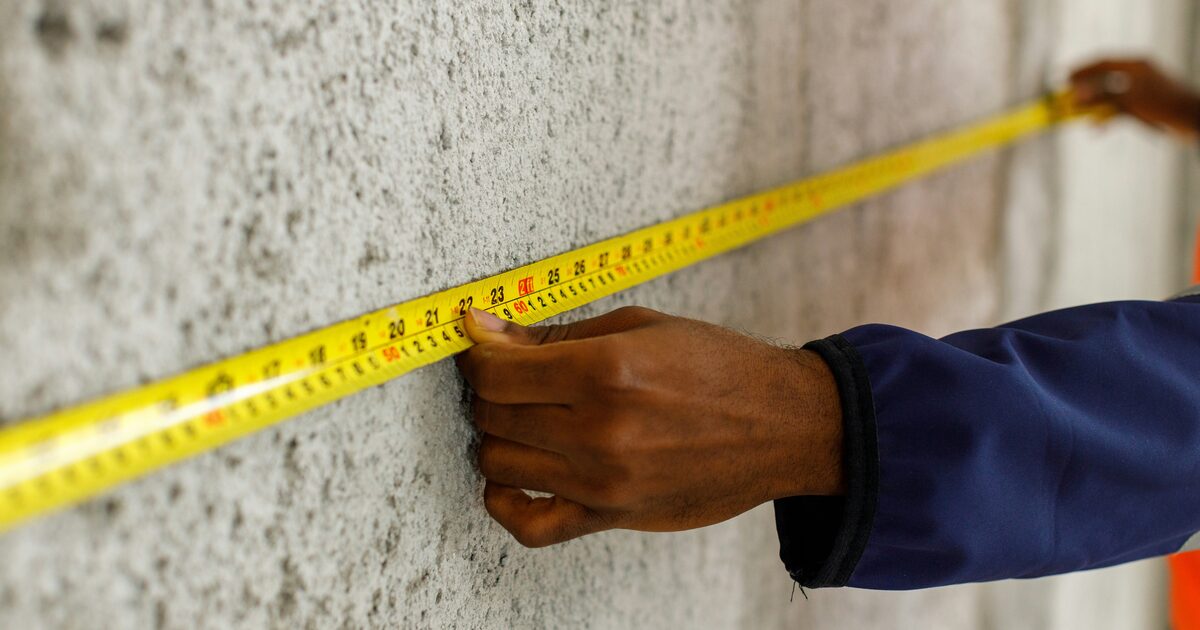
I was measuring windows for new blinds. I had the tape pulled out, I could see the number 34 on the left, and then there were about six tiny lines between 34 and 35 and I had no idea which one the tape was sitting on. I ended up writing down “34 and a little bit” on a piece of paper like that was going to help anyone at the hardware store.
If that sounds familiar, you are not alone. Most people can read the full inches on a tape measure just fine. It is the lines in between that cause problems. The ones that get smaller and smaller until they look like they were drawn by a spider. Nobody ever sits you down and explains what they mean. You are just supposed to know, and if you do not, you feel dumb for asking.
This is the explanation I wish someone had given me. No jargon. No assumptions. Just what each line means so you can get the right number and get on with your project.
The Big Idea: Smaller Lines Mean Smaller Fractions
Every tape measure uses the same system. The taller the line, the bigger the fraction. The shorter the line, the smaller the fraction. That is the whole trick. Once you understand that, everything else is just counting.
Between any two inch numbers on a standard tape measure, there are 16 spaces divided by lines of different heights. Those lines mark halves, quarters, eighths, and sixteenths of an inch. The tallest line in the middle is the half inch. The next tallest lines are the quarter inches. Then the eighths. And the shortest lines are the sixteenths.
Think of it like a family. The inch marks are the parents (tallest). The half inch is the oldest kid. The quarter inches are the middle kids. The eighths are the younger ones. And the sixteenths are the little ones running around at knee height. You can tell who is who just by how tall they are.
Every Line, Explained
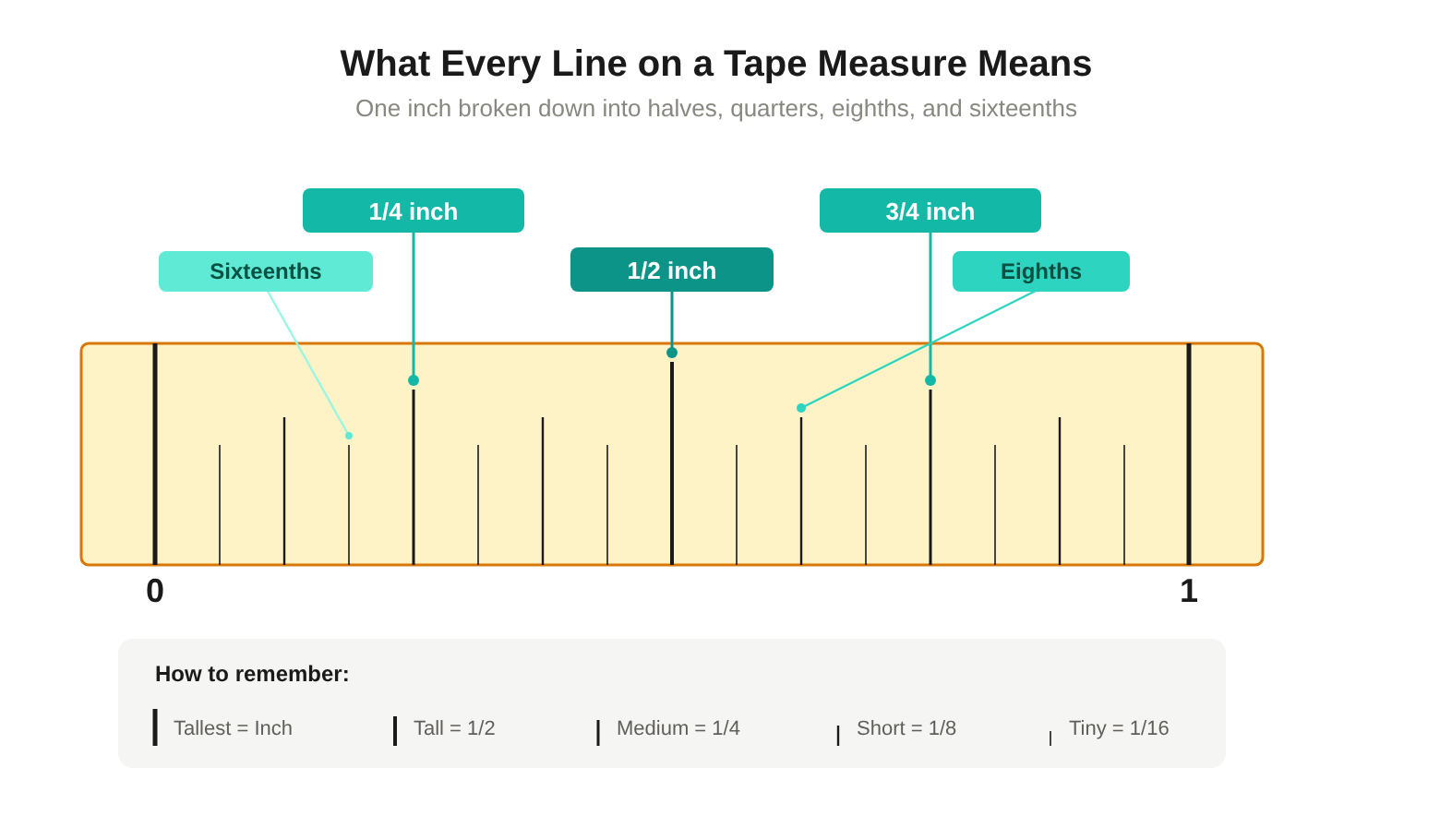
Here is what each line between two inch marks represents, starting with the tallest and working down.
The tallest line in the middle: 1/2 inch. This is the easiest one. It sits exactly halfway between two inch numbers and it is almost as tall as the inch marks themselves. If your measurement lands here, you are at something and a half. Like 34 and 1/2.
The next tallest lines: 1/4 and 3/4 inch. There are two of these between every inch. One sits a quarter of the way in, the other sits three quarters of the way in. They are shorter than the half inch mark but taller than everything else. If you land on one of these, your measurement is something and 1/4 or something and 3/4. Like 34 and 1/4, or 34 and 3/4.
The medium lines: eighths.There are four eighth inch marks between every inch (at 1/8, 3/8, 5/8, and 7/8). These are noticeably shorter than the quarter inch marks. When someone at the hardware store says “five and three eighths” they are talking about the inch mark at 5 plus three of these medium lines past it.
The shortest lines: sixteenths. These are the tiny ones that make people question their eyesight. There are eight sixteenth inch marks between every inch, tucked between the eighth inch marks. Most home projects do not require sixteenth inch precision, but when they do (trim work, cabinetry, picture frames), this is where you end up.
How to Actually Read a Measurement
Here is the step by step process. It takes about five seconds once you get the hang of it.
Start with the whole inches. Find the last full number the tape has passed. If the tape is pulled past the 34 but not to the 35, you are at 34 and something.
Now look at where the measurement actually falls between 34 and 35. Is it on the tall middle line? That is 34 and 1/2. Done.
If it is not on the half, is it on one of the next tallest lines? Those are the quarters. Count from the inch mark: the first tall line after 34 is 1/4, the middle is 1/2, the next tall one is 3/4.
If it is between the quarters, you are in eighth territory. Count the medium sized lines from the inch mark: 1/8, 2/8 (which is 1/4), 3/8, 4/8 (which is 1/2), 5/8, 6/8 (which is 3/4), 7/8.
And if it falls between the eighths, you are down to sixteenths. Count every tiny line from the inch mark up to where your measurement lands. That number over 16 is your fraction. If you count 11 tiny lines past the inch, you are at 11/16.
If counting sixteenths makes your head hurt, you are not alone. That is exactly why we built the Tape Measure Converter. Plug in the fraction and it converts it to a decimal, or plug in a decimal and it gives you the fraction. No math required.
The Fractions That Trip Everyone Up
Some fractions are easy. Half inch, quarter inch, even three quarters. Those feel natural. But then you run into measurements like 7/16 or 11/32 and suddenly you are staring at the tape like it is written in another language.
Here are the most common tricky fractions and what they actually look like on the tape.
5/16 inch is the fifth tiny line past the inch mark. It is just a hair past 1/4 (which is 4/16). If you can find the 1/4 mark, go one more tiny line. That is 5/16.
7/16 inch is the seventh tiny line past the inch mark. It is just below 1/2 (which is 8/16). Find the half inch mark and go one tiny line back toward the inch. That is 7/16.
9/16 inch is one tiny line past the 1/2 mark. If you can find the half, you can find 9/16.
11/16 inch is three tiny lines past the 1/2 mark, or one line past the 5/8 mark. This is the one that gets people most often because it sits in the busy zone between 1/2 and 3/4 where the lines are packed tight.
The cheat:if you ever get lost, count every line (regardless of height) from the inch mark. Each one is a sixteenth. Count them, put that number over 16, and you have your measurement. Then simplify if you can. 4/16 is 1/4. 8/16 is 1/2. 12/16 is 3/4. If it does not simplify neatly, just leave it as sixteenths. Nobody is going to judge you for saying “five and eleven sixteenths” instead of trying to reduce it on the spot.
Fractions to Decimals: The Quick Reference
Sometimes you need the decimal version of a fraction. This happens when you are ordering something online and the product dimensions are in decimals, or when a calculator asks for a measurement in inches as a decimal number.
Here are the conversions you will use most often.
1/16 = 0.0625. 1/8 = 0.125. 3/16 = 0.1875. 1/4 = 0.25. 5/16 = 0.3125. 3/8 = 0.375. 7/16 = 0.4375. 1/2 = 0.5. 9/16 = 0.5625. 5/8 = 0.625. 11/16 = 0.6875. 3/4 = 0.75. 13/16 = 0.8125. 7/8 = 0.875. 15/16 = 0.9375.
You do not need to memorize that list. The ones worth knowing by heart are 1/4 (0.25), 1/2 (0.5), 3/4 (0.75), 1/8 (0.125), and 3/8 (0.375). Everything else, use the Tape Measure Converter and let it do the math.
The Special Markings Nobody Explains
If you have ever looked closely at a tape measure, you may have noticed some extra markings that do not seem to follow the pattern. Here is what they are.
Red numbers or marks every 16 inches. These indicate standard stud spacing. When framing a wall, studs are placed 16 inches apart on center. The red marks help framers find stud locations quickly without counting. If you are hanging something heavy on a wall and need to find a stud, measure 16 inches from a corner and you are probably close.
Black diamond marks every 19 3/16 inches. These are for roof truss spacing. Five trusses fit evenly across an 8 foot sheet of plywood at this spacing. Unless you are framing a roof, you can ignore these entirely.
The first inch is shorter. Some tape measures have a slightly shorter first inch. That is not a manufacturing defect. The metal hook at the end is designed to slide in and out slightly. When you push it against something for an inside measurement, it slides in. When you hook it on the edge of something for an outside measurement, it slides out. That movement compensates for the thickness of the hook itself so your measurement is accurate either way.
Tips That Would Have Saved Me a Trip Back to the Store
Measure twice and write it down immediately. I cannot tell you how many times I measured something, walked to the garage, and forgot the number by the time I got there. Take a photo of the tape at the measurement. Your phone camera is a notepad.
Use the tape's body for inside measurements. When you are measuring the inside of a window frame or a cabinet opening, you cannot get the tape flat into the corner. Push the tape body into one side and read the tape, then add the length of the tape body (printed on the back of most tape measures, usually 3 or 3.5 inches) to get the total.
Round to the nearest eighth for most home projects. Unless you are doing fine woodworking or trim work, sixteenth inch precision is overkill. If your measurement falls between two eighth inch marks, round to the closest one. For curtains, shelving, and basic cuts, an eighth of an inch is more than accurate enough.
Subtract, do not add, when cutting.The old carpenter's rule is “measure twice, cut once.” But there is a second rule that matters just as much: if you are cutting something to fit inside a space, subtract 1/16 to 1/8 from your measurement. Wood and trim need a little wiggle room. If you cut it exactly to the measurement, it will be too tight and you will be shaving it down with sandpaper.
If you are working on a bigger project and need to convert your tape measure readings into square footage for materials like paint, flooring, or tile, that calculator now accepts measurements in both feet and inches.
Stop Guessing
Reading a tape measure is one of those skills that feels embarrassing to not know, which is exactly why most people never ask. They just guess and hope it works out. Sometimes it does. Sometimes they end up with blinds that are a quarter inch too wide and a return trip to the store.
Now you know what every line means. The tall ones are halves and quarters. The medium ones are eighths. The tiny ones are sixteenths. Start from the inch mark, count lines, and you have your measurement.
And when the math gets annoying, the Tape Measure Converter is free and it does not judge you for using it.
This guide covers standard U.S. tape measures marked in inches and fractions. Metric tape measures use millimeters and centimeters with a different marking system. All tips in this article are general guidance. For precision woodworking or construction, consult a professional.