
Tire Cost Per Mile: Which Tire Is Actually Cheaper in 2026?
The cheapest tire on the shelf is not always the cheapest tire to own. The number that tells you the truth is cost per mile, and it almost never matches the price on the sticker.
You walk into the tire shop. One tire is $110. The one next to it is $175. The $110 tire looks like the smart buy. You save $65 a tire, $260 across a full set, and the rubber looks close enough.
Then the cheap set wears out at 45,000 miles and you are back in the same chair two years sooner. The expensive set would have run to 75,000. Suddenly the math flips, and the tire that cost more at the counter cost less to own.
The number that catches this is cost per mile. It is the only honest way to compare two tires, and it is the same number a trucking fleet uses to decide whether to buy new or run a retread. Here is how it works and how to run it for your own vehicle.
What cost per mile actually means
Cost per mile is the price of the tire spread across every mile it will carry you. The formula is simple:
Cost per mile = (price per tire x number of tires) / expected tire life in miles
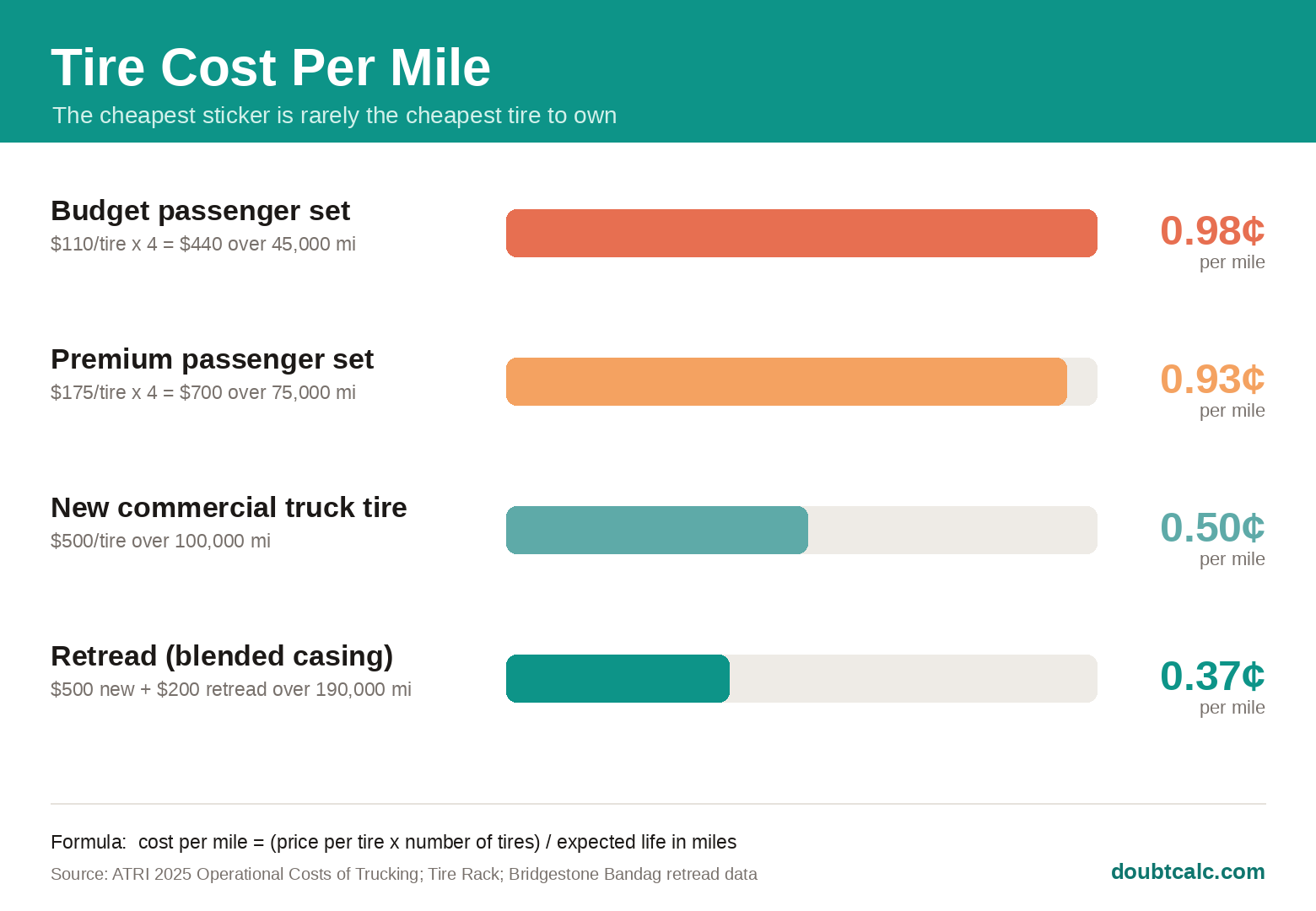
A set of four tires at $175 each is $700. If they last 75,000 miles, that is $700 divided by 75,000, or about $0.0093 per mile. Just under a penny a mile to keep your car on the road.
It looks like a tiny number because it is. But that is the point. Tires are one of the few car costs you can compare cleanly before you spend a dollar, as long as you measure them the same way. Price alone hides the lifespan. Cost per mile puts price and lifespan in the same number so you can line two tires up side by side. The fastest way to do that is to drop both into our tire cost per mile calculator and let it do the division.
Why the cheap tire often loses
Go back to the two tires from the shop. Run them both as a set of four.
- Budget tire: $110 each, 45,000-mile life. $440 / 45,000 = about $0.0098 per mile.
- Premium tire: $175 each, 75,000-mile life. $700 / 75,000 = about $0.0093 per mile.
The premium tire is cheaper per mile, and it lasts 30,000 miles longer, which means one fewer trip to the shop, one fewer mounting and balancing fee, and one fewer day off the road. The $260 you saved up front quietly turned into a loss.
Now here is the honest part most tire articles skip. The cheap tire does not always lose. If that budget tire actually delivers 50,000 miles instead of 45,000, the math swings: $440 / 50,000 is about $0.0088 per mile, and now it beats the premium tire. The whole answer rides on the real life each tire delivers, not the rating on the label. That is exactly why you run your own numbers instead of trusting a blanket rule that premium always wins.
The treadwear warranty trap
That 80,000-mile warranty on the sidewall feels like a promise. It is not. A treadwear warranty is prorated and only pays out when all four tires reach 2/32 of an inch of remaining tread, which is the legal wear limit. Get there at 60,000 miles instead of 80,000 and you do not get a check. You get a credit toward your next set, sized to how far short you fell.
Most of these warranties also expire 4 to 6 years from the purchase date. And tires age out on their own in roughly 6 to 10 years no matter how much tread is left, because the rubber hardens and cracks with time. A low-mileage driver can need new tires from age alone, long before the tread wears down.
The takeaway: plug realistic miles into your cost per mile, not the warranty headline. If you drive 12,000 miles a year, an 80,000-mile tire is really a 6-to-7-year tire, and age may retire it before the mileage ever does.
For trucks and fleets, cost per mile is the whole game
If you run a truck for a living, you already think in cost per mile, because every cost on a truck gets measured that way. According to the American Transportation Research Institute, the average marginal cost to operate a truck hit $2.260 per mile in 2024. Tires were $0.047 of that, up 2.2 percent from the year before and climbing steadily from $0.041 in 2021.
Tires are not the biggest line on the sheet, but they are one of the most controllable. A truck running 100,000 miles a year at $0.047 per mile spends about $4,700 a year just on tires. Shave even a half cent off that number across a fleet and the savings stack up fast. That is why fleets obsess over cost per mile instead of unit price, and why the calculator was built to handle all 18 positions on a tractor-trailer at once, not just a single tire.
Retreads change the math
A retread is a sound used tire casing with fresh tread bonded onto it. In trucking it is not a corner-cut, it is standard practice. FedEx, UPS, and Schneider all retread drive and trailer tires as a matter of policy, and the industry saves billions a year doing it.
The reason is cost per mile. A retread runs roughly 30 to 50 percent less than a new tire, often $150 to $250 against $400 to $600 or more for new. Because the same casing gets reused across the original tread plus one or more retread cycles, the blended cost per mile drops well below buying new every single time.
Run the blend. Say a new drive tire is $500 and delivers 100,000 miles. Retread it once for $200 and get another 90,000 miles out of the casing. New tire alone is $500 / 100,000, or $0.0050 per mile. Blend the casing across both cycles and it is $700 across 190,000 miles, about $0.0037 per mile. That is roughly a 26 percent cut, on the same casing, just by reading the cost per mile instead of the unit price.
Most fleets run a position-based strategy: new premium tires on the steer axle for control, a mix on the drives, and maximum retread use on the trailer where the cost savings matter most and the risk is lowest. The tire cost per mile calculator has a retread option built in so you can compare a new-only tire against a casing you retread, and it blends the two cycles into a single cost per mile for you.
How to run your own number
Whether you are picking tires for a sedan or speccing them for a rig, the inputs are the same three:
- Price per tire, installed if you can get the out-the-door number
- Number of tires you are buying
- Expected life in miles, using a realistic figure, not the warranty number
For the lifespan, lean conservative. If a tire is rated for 70,000 miles, real-world wear, alignment, and your driving usually land it somewhere short of that. Running a slightly lower number protects you from the trap of a tire that looked cheap per mile only because you trusted the sticker.
Plug those three into our tire cost per mile calculator. You can line up to three options side by side, add a retread cycle to any of them, and it flags the lowest cost per mile so you are comparing real numbers instead of price tags.
The short version
The sticker price tells you what you pay today. Cost per mile tells you what the tire actually costs to own. A pricier tire that lasts longer often wins, but not always, so the only way to know is to run the math on the real miles each tire delivers. Treadwear warranties are a credit, not a promise. And if you run trucks, retreads can cut your cost per mile by a quarter or more on the same casing.
Buy the lowest cost per mile, not the lowest price. The two are rarely the same tire.
Run the numbers
Tire Cost Per Mile Calculator
Compare up to three tires by cost per mile, with a retread option built in
Tire Size Comparison Calculator
Check how a new tire size changes diameter, speedometer, and clearance
Cost Per Mile Calculator
Add up fuel, maintenance, and wear to see what each mile really costs you
Owner Operator Profit Calculator
See how tire and fuel cost per mile flow through to take-home pay
Sources
- American Transportation Research Institute, An Analysis of the Operational Costs of Trucking: 2025 Update (2024 cost data, tires at $0.047 per mile).
- Consumer Reports and Tire Rack, tire lifespan and treadwear mileage warranty guidance (passenger tire life and 2/32-inch wear limit).
- Bridgestone Bandag and industry fleet data on retread cost savings versus new commercial tires.