
What Are Deadhead Miles? The Real Cost of Driving Empty in 2026
The rate on the load board is per loaded mile. The number that pays your bills is per total mile, and the empty miles in between are quietly eating your profit.
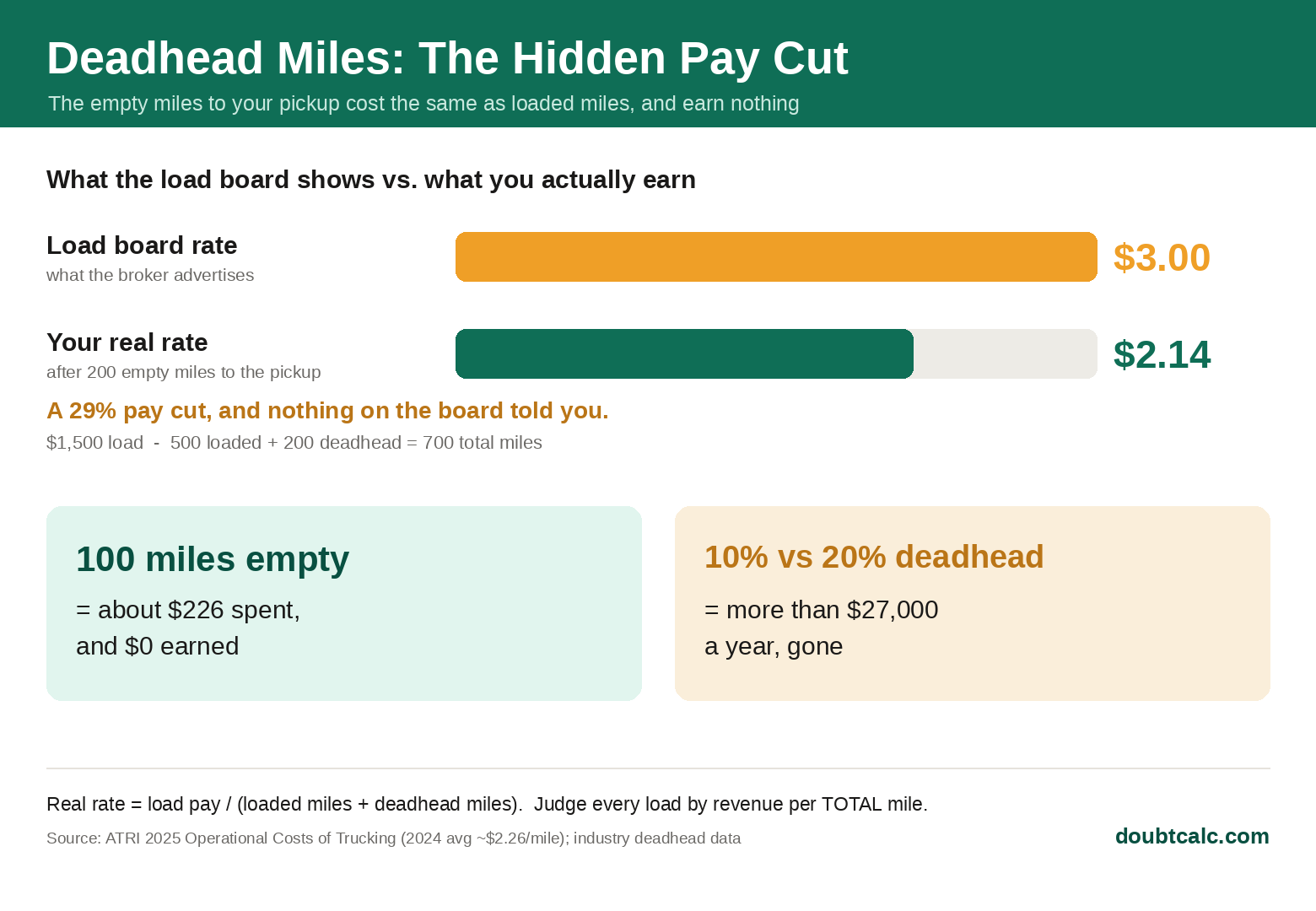
You take a load that pays $3.00 a mile. Sounds strong. But the pickup is 200 miles from where you sat down, and you drive every one of those miles empty to get there. The load board never mentioned that part.
Those empty miles have a name. Deadhead. And they are one of the biggest reasons a haul that looks profitable on the board turns out thin in the bank. Here is what deadhead miles actually are, what they cost, and how to keep them from draining your year.
What deadhead miles actually are
Deadhead miles are the miles you drive with an empty trailer. No freight, no revenue. They happen most often when you finish one load in one place and the next load picks up somewhere else, so you run empty to reach it.
The truck does not care whether the trailer is loaded. It burns the same fuel, racks up the same wear, and runs down the same clock whether you are hauling 40,000 pounds or hauling air. The only difference is that on deadhead miles, none of that cost is earning anything back.
The number that lies: loaded mile vs total mile
This is the trap that catches new owner-operators. Load boards and brokers quote rates per loaded mile, because that number looks the best. But you do not get paid per loaded mile. You pay your costs per total mile, every mile the wheels turn.
Run the example. A load pays $3.00 per loaded mile across 500 loaded miles, so $1,500. To get to the pickup you deadhead 200 miles. Your total miles are 700, not 500. That $1,500 spread across 700 miles is $2.14 per total mile, not $3.00. The empty run just cut your real rate by 29 percent, and nothing on the load board told you.
That is the single most important habit in this business: judge every load by revenue per total mile, deadhead included. The fastest way to see the real number is to drop the load pay, the loaded miles, and the deadhead miles into our deadhead mile calculator, which shows your revenue per total mile and break-even rate before you commit.
What empty miles actually cost
According to the American Transportation Research Institute, the average marginal cost to operate a truck hit about $2.26 per mile in 2024, counting fuel, maintenance, tires, insurance, permits, and driver pay. That number does not stop on deadhead miles.
So when you drive 100 miles empty to reach a pickup, you just spent roughly $226 to earn nothing. Do that a few times a week and it compounds fast. The difference between running 10 percent deadhead and 20 percent deadhead works out to more than $27,000 a year for a typical over-the-road truck. That is not a rounding error. That is the line between a good year and a hard one.
What counts as a good deadhead percentage
Deadhead percentage is your empty miles as a share of total miles. Most owner-operators land somewhere between 10 and 20 percent. Under 15 percent is solid. Once you climb past 20 percent, you are bleeding profit, and it usually means a lane or a home base that keeps stranding you away from freight.
The fix starts with measuring it. Track your deadhead as a share of total miles every month. You cannot manage a number you never look at, and the patterns, certain lanes, certain shippers, certain weeks, only show up once you are watching.
How to cut deadhead miles
You will never hit zero deadhead. Some empty running is unavoidable. But you can shrink it, and a few points of improvement go straight to your bottom line.
- Plan the backhaul before you take the load. Know what freight is leaving the delivery area before you commit to going there.
- Base yourself in or near high-freight lanes. A home location surrounded by outbound freight means shorter empty runs to your next pickup.
- Weigh a cheap repositioning load against deadheading. A short, low-paying load that moves you toward a strong pickup can beat running the same distance empty. Run both scenarios before you decide.
- When deadhead is unavoidable, price it into the rate. If a broker needs you to run 200 miles empty to a pickup, that cost belongs in the load price. Show them the math.
That last point is where the calculator earns its keep at the negotiating table. When a broker hears "I need more for this lane," that is opinion. When you can say "200 deadhead miles at $2.26 a mile is $452 of cost this rate does not cover," that is math, and it is a lot harder to argue with.
The short version
Deadhead miles are the empty miles you drive to reach freight, and they cost the same as loaded miles while earning nothing. The rate per loaded mile is marketing. The rate per total mile is reality. Keep your deadhead under 15 percent, measure it every month, and price the unavoidable empty miles into your rates.
Before you take the next load, run it by total miles, not loaded miles. The board shows you the number that sells the load. Cost per total mile shows you the number that pays your bills.
Run the numbers
Deadhead Mile Calculator
See revenue per total mile, net profit, and break-even rate for any load
Cost Per Mile Calculator
Add up fuel, maintenance, and fixed costs to find your true cost per mile
Owner Operator Profit Calculator
See what you actually take home after every cost of running the truck
Load Profitability Calculator
Decide whether a specific load is worth taking before you book it
Sources
- American Transportation Research Institute, An Analysis of the Operational Costs of Trucking: 2025 Update (2024 marginal cost of about $2.26 per mile).
- Industry freight and dispatch data on average deadhead percentages and the yearly cost of empty miles for owner-operators.