
Why Your Flight Always Takes Longer Than Booked
The number on your ticket is almost never the number that ends up on the clock. Here is what actually adds time to your trip, and how to plan for it without showing up two days early.
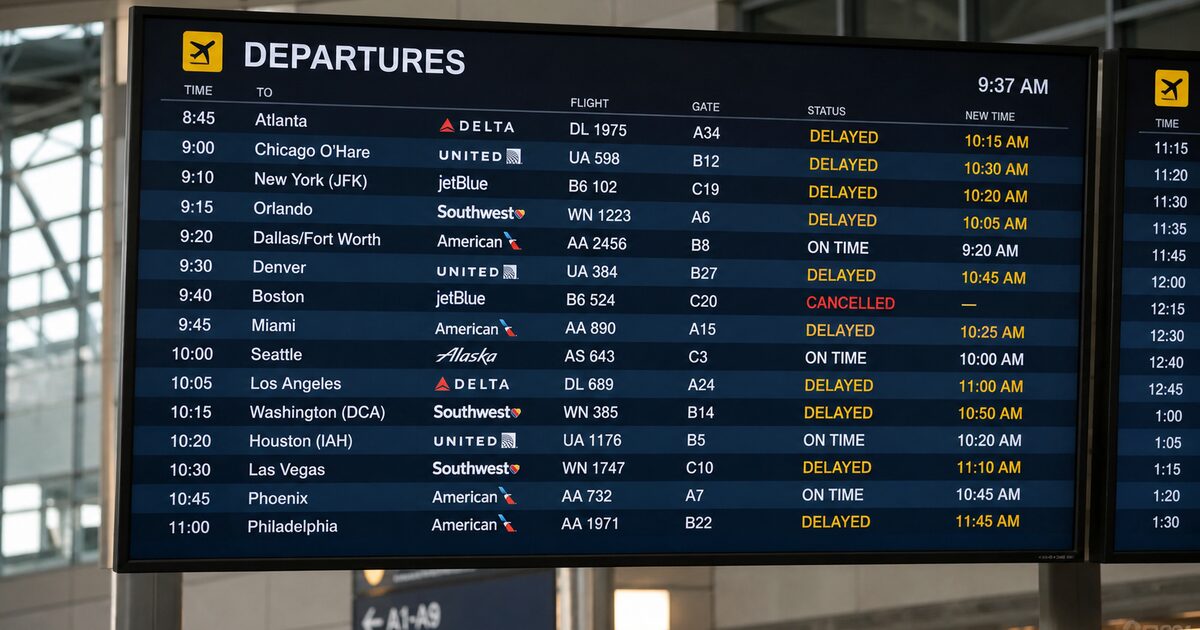
You book a 7-hour flight. You arrive at the airport 2 hours early. You land an hour late, wait 30 minutes for bags, fight traffic to your hotel. Suddenly the 7-hour trip ate 12 hours of your day.
Most of that gap is predictable. Time zones, jet stream physics, layover math, and current delay statistics explain almost all of it. The booked flight time is a small piece of what travel day actually costs you.
This is what to think about when you are running the numbers yourself.
Time zones turn arrival times into a guessing game
A flight from New York to London that departs at 8 PM arrives around 8 AM local time. On the ticket, that looks like a 12-hour flight. It is not. It is closer to 7 hours of actual flying plus a 5-hour time change.
Westbound trips do the opposite. London to New York leaves at 10 AM and lands at 12:30 PM the same day on the ticket. The flight is still around 8 hours. The clock just moves backward.
If you are mentally calculating travel time by subtracting departure from arrival in the booking, you are getting a number that has nothing to do with how long you will be on the plane. To find the real flight time you need to convert both ends to the same time zone first, then subtract. The quickest way to do this for any city pair is to plug both airports into our flight time calculator, which handles the time zone math automatically.
The jet stream changes east vs west by an hour
If you have flown a route both directions and noticed one leg always feels longer, you are right. The jet stream is a river of air at cruising altitude that moves west to east across most of the Northern Hemisphere at 100 to 200 mph.
Eastbound flights ride that current. The plane is moving through the air at the same speed, but the air itself is pushing forward. Ground speed climbs. A New York to London eastbound flight typically takes 6 hours 50 minutes to 7 hours 30 minutes.
Westbound flights fight it. Same plane, same air speed, but now the wind is pushing back. Ground speed drops. The reverse leg from London to New York routinely runs 7 hours 30 minutes to 8 hours 30 minutes. In winter, when the jet stream is strongest, the gap can climb past an hour.
This is not just transatlantic. Coast-to-coast flights inside the US show the same pattern. Los Angeles to New York typically books for 5 hours 10 minutes. The return is 6 hours 30 minutes. Same plane. Same crew. Just wind.
Layovers eat more time than the schedule shows
Airlines publish minimum connection times for every airport they serve. The MCT is the shortest layover the airline will book on a single ticket. At efficient hubs, that can be as low as 30 to 45 minutes for domestic-to-domestic transfers. For international transfers at larger airports, the floor is usually 90 to 180 minutes.
The MCT is not a recommendation. It is the airline saying this is mathematically possible if everything goes right. Inbound flight on time, no terminal change, security and customs not backed up, no delay in deplaning. Anyone who has flown more than a couple of times knows how often all four are true at once.
A safer rule for normal travel: 90 minutes for domestic connections, 3 hours for international. Add another 30 to 60 minutes if you are changing carriers, because checked bags may have to be reclaimed and re-checked instead of interlined. Add even more if either flight is on an airline with a poor on-time record.
Delays are worse than they used to be
According to the US Bureau of Transportation Statistics, about 76.49 percent of US flights arrived on time during the first nine months of 2025. That means roughly one in four flights was delayed by 15 minutes or more. In the second quarter of 2025, the rate climbed: nearly 25 percent of domestic flights missed the on-time mark, the worst performance since 2014.
The on-time definition matters. A flight that arrives 14 minutes late counts as on time. A flight that arrives 16 minutes late counts as delayed. When you are planning ground transportation, hotel check-in, or a connection, that 30-minute window can swing your whole day.
Some airlines run noticeably better than others. Hawaiian Airlines posted the best on-time arrival rate among US carriers in the first half of 2025 at 83.1 percent. PSA Airlines ranked last among 21 US carriers at 65.7 percent. The difference between those two is more than 17 percentage points, which is enough to factor into booking decisions if your trip is time-sensitive.
The booked time does not include the airport
When the airline publishes a 3-hour flight, they are measuring gate to gate. Pushback, taxi, takeoff, cruise, descent, landing, and taxi to arrival gate. That number does not include any of the airport time on either end.
Realistically, a 3-hour booked flight breaks down like this:
- Arrive at airport: 90 minutes before boarding for domestic, 2 to 3 hours for international
- Boarding: 30 to 45 minutes
- Flight (gate to gate): 3 hours
- Deplaning: 15 to 30 minutes
- Baggage claim: 20 to 40 minutes if you checked bags
- Transit to destination: variable
A 3-hour ticket easily becomes a 6-hour travel day before anything goes wrong. If the flight is delayed, if the connection slips, if customs is backed up, that number grows fast.
A practical formula for planning flight time
When you need a number for actual travel time, start with the booked flight time and add the layers:
- Airport arrival buffer: 90 to 180 minutes
- Booked flight time: gate to gate
- Realistic delay buffer: 30 minutes (15 to 60 depending on the airline and route)
- Deplaning and bags: 30 to 60 minutes
- Layover real value: schedule plus 30 minutes if you are connecting
- Time zone change: add or subtract from the clock, but does not change your body clock
For a one-leg domestic trip, that usually means your travel day is about double the booked flight time. For an international trip with a connection, plan on triple. If the trip absolutely must happen on a specific day, fly the day before for international, or take the earliest flight that meets your timing window so you have rebooking options if it breaks.
And if you are just trying to figure out how long an actual flight will take between two specific airports, our flight time calculator handles the distance, time zone, and east-versus-west math so you do not have to think about the jet stream yourself.
The short version
The booked flight time is a sliver of your travel day. Time zones make arrival math misleading. The jet stream means eastbound and westbound trips are not the same length. Layovers eat more than the MCT suggests. About one in four US flights ran late in 2025. None of this is fixable, but all of it is plannable.
Build your travel day around real numbers, not the marketing number on the ticket. Your sanity at the destination depends on it.
Run the numbers
Flight Time Calculator
Real flight times between any two cities with time zone math handled
Time Zone Converter
Convert times across cities to figure out what local time you will arrive
Vacation Budget Calculator
Plan the rest of the trip cost: flights, hotels, activities, food
Road Trip Budget Calculator
Skip the airport entirely. Plan the drive instead.
Sources
- US Bureau of Transportation Statistics, on-time arrival rates and delay causes (2025 data).
- Industry minimum connection time standards published by airlines and airports for major US hubs.