
We looked at current 2026 pricing from contractor estimates, material suppliers, and industry cost data to break this down with real numbers. Not ranges from 2019. Not “it depends.” Actual per-square-foot costs you can use to make a decision this weekend.
The raw numbers: deck vs patio per square foot
Here is what you are looking at per square foot in 2026, installed with labor:
| Option | Cost per sq ft | 300 sq ft total |
|---|---|---|
| Concrete slab | $4 to $16 | $1,200 to $4,800 |
| Stamped concrete | $9 to $33 | $2,700 to $9,900 |
| Paver patio | $12 to $40 | $3,600 to $12,000 |
| Wood deck (pressure-treated) | $25 to $50 | $7,500 to $15,000 |
| Composite deck | $35 to $70 | $10,500 to $21,000 |
On paper, a basic concrete patio costs one-fifth to one-third of what a wood deck costs. A 300 square foot concrete slab might run $3,000 while the same size pressure-treated deck comes in around $10,000. That is a significant gap, and for many homeowners it ends the conversation right there.
But the per-square-foot number does not tell the whole story. Your yard, your climate, and what you plan to do on that outdoor space all change the math. Use our deck cost calculator or paver patio calculator to plug in your own dimensions and get a personalized estimate.
Scenario 1: The flat suburban backyard on a budget
The situation: You have a flat, graded lot behind a three-year-old house. You want somewhere to put a table and chairs, maybe a fire pit. You are not trying to impress anyone. You just want to stop eating dinner on the grass.
The winner: patio. On a flat lot with decent soil, a concrete slab is the cheapest outdoor surface you can pour. A 12x20 slab (240 square feet) will run you $1,500 to $3,800 installed. That same space as a pressure-treated deck would cost $6,000 to $12,000. There is no scenario math where the deck wins here unless you have a specific reason you need a raised surface.
If you want something that looks nicer than plain concrete, stamped concrete adds about $5 to $12 per square foot, putting that same 240 square foot space at $3,400 to $6,700. Still well under a deck.
Scenario 2: The sloped lot that needs grading
The situation: Your backyard drops two to three feet from the house to the back fence. A patio needs flat ground. A deck can ride on posts over the slope.
The winner: deck. Grading a moderate slope for a patio adds $1,000 to $5,000 to the project, depending on how much dirt needs to move and whether you need a retaining wall to hold the new grade. A small retaining wall alone can run $2,000 to $6,000. Once you add those site prep costs to the patio price, the gap between a patio and a deck shrinks fast, and sometimes the patio ends up costing more.
A deck on the same sloped lot just needs longer posts on the downhill side. The framing and decking cost stays the same regardless of the slope. If your yard drops more than about 18 inches across the area where you want outdoor space, get a deck quote before you assume a patio is cheaper.
Scenario 3: You want an outdoor kitchen
The situation: You are picturing a built-in grill, a countertop, maybe a pizza oven. You want to cook outside for real, not just wheel a Weber to the edge of a deck.
The winner: patio. An outdoor kitchen needs a non-combustible surface. You cannot safely build a masonry grill station or a stone countertop on a wood deck without significant fire-rated modifications. Even composite decking manufacturers warn against placing grills directly on their products.
A paver or concrete patio gives you a fireproof, level surface that can support the weight of stone countertops and heavy appliances without worrying about load limits or fire codes. If cooking outdoors is the primary goal, a patio is the obvious choice.
Scenario 4: You are selling in three to five years
The situation: You want to add outdoor living space, but you are not the one who is going to enjoy it for 20 years. You want the best return on your money when you sell.
The winner: it depends on your budget. Decks return more as a percentage of their cost. The 2025 Cost vs Value report shows a wood deck recoups about 95 percent of its cost at resale, and composite recoups about 89 percent. Paver patios return around 69 percent.
But percentages can be misleading. If you spend $3,000 on a concrete patio and recoup 70 percent, you lost $900. If you spend $18,000 on a wood deck and recoup 95 percent, you lost $900. The dollar loss is the same, but one project cost $15,000 more out of pocket. If you are selling soon and cash flow matters, a nice patio gives you outdoor living space for a fraction of the investment. For a deeper breakdown of deck ROI, see our article on how much a deck costs in 2026.
Scenario 5: You hate maintenance
The situation: You do not want to stain anything, seal anything, or power wash anything more than once a year. You want to build it and forget about it.
The winner: patio (or composite deck if you insist on a deck). A pressure-treated wood deck needs staining every two to three years at $550 to $1,700 per cycle. Over 15 years, that is $2,750 to $12,750 in maintenance alone. A concrete patio needs resealing every two to three years at $100 to $300. Pavers need re-sanding every three to five years at $200 to $500.
If you are dead set on a deck, composite decking (Trex, TimberTech) solves the maintenance problem. It costs $35 to $70 per square foot installed, which is more than wood, but it lasts 25 to 50 years with virtually no upkeep beyond an annual wash. Run the numbers on our deck cost calculator to compare wood versus composite over your time horizon.
Scenario 6: You want both (and that is actually smart)
The situation: You want a place to sit that is level with the back door (deck) and a larger entertaining area in the yard (patio). You do not want to choose.
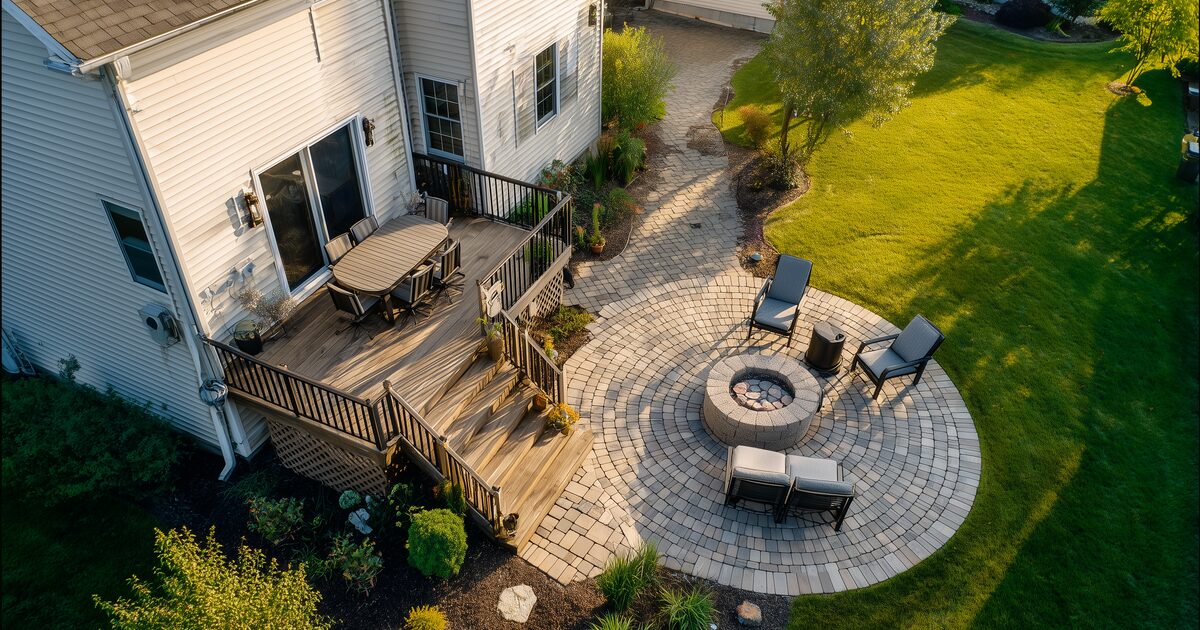
The move: Build a small deck (8x12 or 10x12) off the back door and step down to a paver or concrete patio below. This is more common than people think, and it often makes more sense than trying to deck the entire space.
A 96 square foot composite deck ($3,400 to $6,700) plus a 200 square foot paver patio ($2,400 to $8,000) gives you nearly 300 square feet of outdoor space for roughly $5,800 to $14,700. That is comparable to decking the whole area, but you get the best of both worlds: a clean transition from the house and a ground-level area for furniture, a fire pit, or kids running around.
The 10-year cost of ownership
Upfront cost is only half the equation. Here is what each option actually costs over a decade when you factor in maintenance:
| Option (300 sq ft) | Build cost | 10-yr maintenance | 10-yr total |
|---|---|---|---|
| Concrete slab | $3,000 | $500 to $1,000 | $3,500 to $4,000 |
| Paver patio | $6,000 | $500 to $1,500 | $6,500 to $7,500 |
| Wood deck | $10,000 | $2,000 to $6,000 | $12,000 to $16,000 |
| Composite deck | $15,000 | $300 to $500 | $15,300 to $15,500 |
Notice how a wood deck's 10-year cost approaches composite once you add staining and repairs. And a basic concrete patio's total cost stays under $4,000 for a full decade. If budget is the primary constraint, concrete wins by a wide margin no matter how you slice it.
How long will it last?
Patios outlast decks in almost every case. A concrete slab lasts 30 or more years. Pavers can last 50 or more years because their flexible sand joints absorb ground movement that would crack a solid slab. Pressure-treated wood decks last 10 to 15 years before boards start rotting and need replacement. Composite decking closes that gap with a 25 to 50 year lifespan.
If you are building something you want your grandkids to use, a paver patio or composite deck is the play. If you are building something for the next 10 to 12 years, a pressure-treated wood deck or basic concrete slab both work fine at very different price points.
So which should you build?
If you have a flat yard and a tight budget, pour a patio. If your yard slopes, get a deck quote before you spend money on grading. If you want an outdoor kitchen, go with a patio. If you want a low-maintenance surface connected to your back door, look at composite decking. And if you cannot decide, the small deck plus larger patio combo gives you the best of both worlds without breaking the bank.
Plug your actual dimensions into our deck cost calculator or paver patio calculator to get a personalized estimate. The numbers in this article are national averages. Your local costs could be 15 to 40 percent higher or lower depending on where you live.
Frequently asked questions
Is it cheaper to build a deck or pour a patio?
A patio is almost always cheaper upfront. A basic concrete slab costs $4 to $16 per square foot installed, while a wood deck runs $25 to $50. For a 300 square foot space, that is $1,200 to $4,800 for concrete versus $7,500 to $15,000 for wood. Sloped lots can add $1,000 to $5,000 in grading costs to a patio, which narrows or eliminates the gap.
Does a deck or patio add more value to a home?
Decks return a higher percentage of their cost at resale. A wood deck recoups about 95 percent and composite about 89 percent. Paver patios return about 69 percent. But because patios cost less upfront, the actual dollars lost at resale can be similar.
Which lasts longer, a deck or a patio?
Patios last longer in most cases. Concrete lasts 30 or more years, pavers 50 or more. Pressure-treated wood decks last 10 to 15 years. Composite decking lasts 25 to 50 years, which puts it in the same range as concrete.
Can you build a patio on a sloped yard?
Yes, but grading a sloped yard adds $500 to $5,000 to the project depending on severity. For significant slopes, a deck is often more cost-effective because it spans the grade change on posts without any earthwork.